


WordPress Theme vs Custom Website Design: Which One Should You Choose?
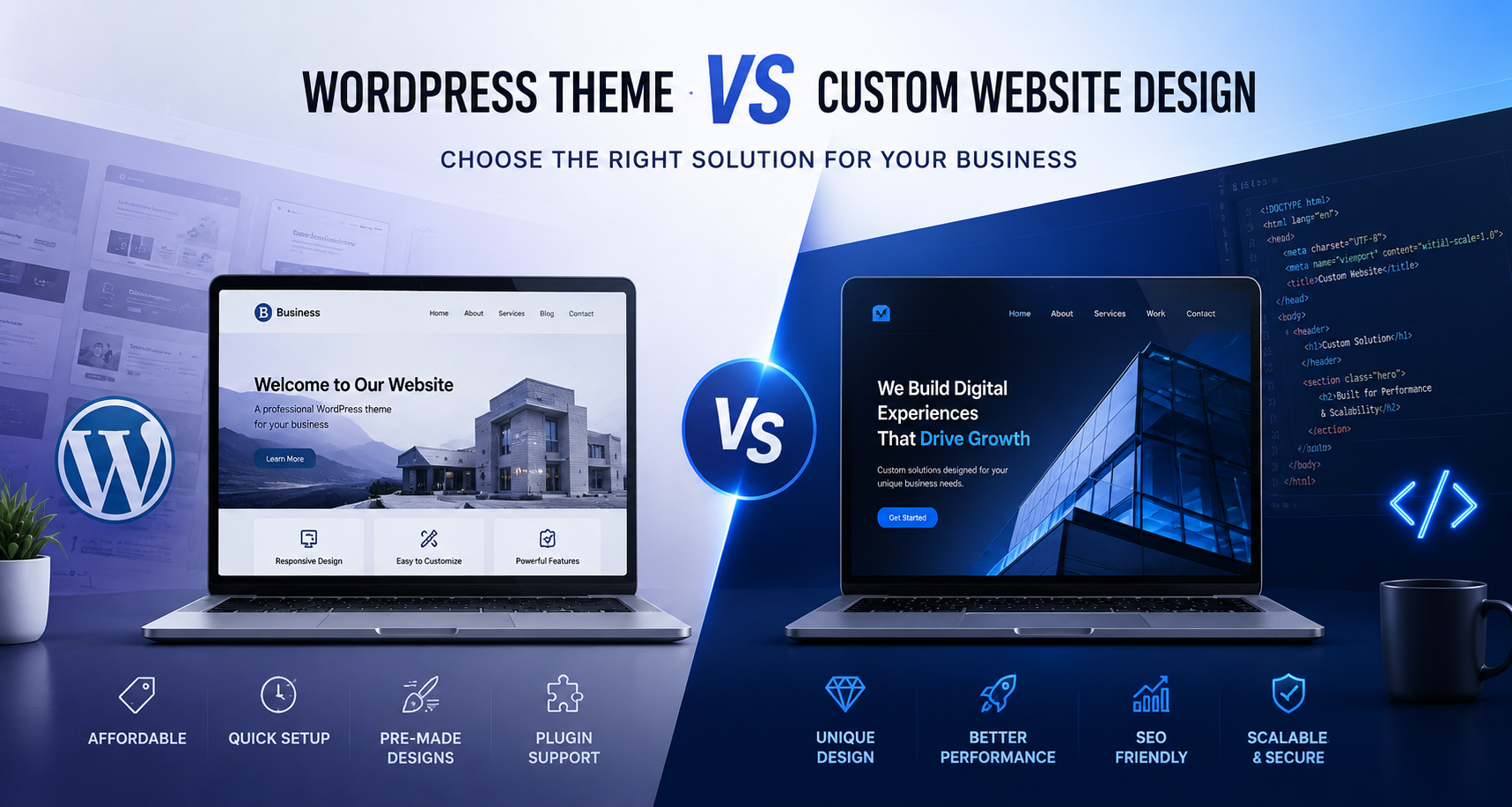
When building a new website, one of the first decisions you’ll face is whether to use a pre-built WordPress theme or invest in a custom-designed website. While themes offer a fast and affordable starting point, custom website development provides greater flexibility, stronger branding, better performance, and long-term scalability.
At Sitemap Web Design Company, we’ve delivered hundreds of WordPress websites across Qatar since 2011, ranging from simple brochure websites to enterprise portals, government platforms, eCommerce stores, and custom CRM integrations. One lesson remains consistent:
“The best choice depends on your business goals—not simply your budget.”
Let’s compare both approaches to help you make the right decision.
What Is a WordPress Theme?
A WordPress theme is a ready-made website template that controls the appearance and layout of your website. Popular marketplaces offer thousands of themes covering nearly every industry.
Typical Features Include:
Advantages of Using a WordPress Theme
1. Lower Initial Cost
Themes are significantly cheaper than custom development. Many premium themes cost less than the price of a single day of professional development.
Ideal for: Startups & small projects
2. Faster Launch Times
A theme allows your website to go live within days rather than weeks, keeping you fast when launching or testing new ideas.
Ideal for: Quick MVP testing
3. Expansive Industry Selection
Thousands of pre-built options cater straight to distinct niches: whether you run a restaurant, clinic, school, hotel, or construction corporation.
4. Core Plugin Compatibility
Most reputable options work right out of the box with vital tools like WooCommerce, Elementor, Rank Math/Yoast SEO, WPForms, and WP Rocket caching layers.
Disadvantages of WordPress Themes
Although themes appear attractive, they often come with hidden performance and technical drawbacks.
Generic Design Foundations
Thousands of competing businesses use the exact same layouts. Your brand may struggle heavily to stand out visually.
Code & Script Bloat
Bundled with features you’ll never use—unused animation scripts, massive icon sets, and heavy sliders that destroy page load speeds.
Rigid, Difficult Customization
Modifying checkout flows or responsive structures often forces messy developer overrides, child themes, or expensive custom code hacks.
Developer Dependency & Abandonment
If creators stop updating the core framework, security vulnerabilities skyrocket and core plugin conflicts quickly compromise your structure.
What Is a Custom Website?
A custom website is designed and developed specifically for your business goals from the ground up. Every single view, interactive animation, conversion journey, and functional layout is engineered carefully around your brand identity instead of adapting your operational workflows to squeeze into a rigid pre-packaged template.
✔ Unique Brand Identity
Every design choice adapts to your distinct typography, messaging, colors, and exact UX pipeline. No competitor will copy your footprint.
✔ Maximum Core Performance
Custom solutions execute code natively. Zero excessive elements mean lightning-fast loading speeds, optimized server usage, and flawless mobile performance.
✔ Engineered Search Engine Value (SEO)
Developers map out exact heading structures, clean semantic HTML hierarchies, advanced schemas, and native lazy-loading routines to optimize index indexing capacity.
✔ Infinite Enterprise Scalability
Integrate localized custom CRM modules, enterprise ERP networks, advanced API frameworks, and booking engines as your target workflows expand over the years.
The Technical Face-off
How themes stack against fully custom architectures across key technical categories.
| Performance Factor | WordPress Theme | Custom Website Architecture |
|---|---|---|
| Loading Speed | Moderate | Excellent |
| Core Web Vitals Metric | Average | Excellent Clean Score |
| Code Optimization | Varies (Bloated frequently) | Fully Streamlined |
| Schema Markup Logic | Limited / Auto-generated | Bespoke Structural Customization |
| Mobile Adaptation UX | Good Fluid Baseline | Pixel-Perfect Layouts |
| Organic Ranking Potential | Good baseline | Maximum Algorithmic Edge |
When to Select a Theme
- ▪ You operate with highly restricted initialization budgets.
- ▪ Launch deadlines demand deployment speed inside a week.
- ▪ Baseline text informational content pages are all that you require.
- ▪ You are simply proving a localized product idea market footprint.
When to Select Custom Builds
- ▪ An unique brand footprint and clear luxury layout identity are mandatory.
- ▪ Organic high-intent search generation (SEO) is your primary acquisition tool.
- ▪ Complex technical application workflows or ERP systems require native integration.
- ▪ You require iron-clad application code security and minimal attack vectors.
Our Strategic Recommendation
For businesses where the digital portal acts as an active sales pipeline, marketing engine, or consumer community hub, investing in a custom-built solution delivers higher compounding long-term returns. Rebuilding an unoptimized layout later always forces difficult data migrations, link map breaking, and expensive redesign overheads.
However, starting out via lightweight, secure, and properly optimized themes is still a reliable route for localized modern startups with immediate budget boundaries.
Why Partner With Sitemap Web Design?
We analyze your direct timeline, requirements, and multi-year goals and objective frameworks. Our localized Doha expert infrastructure delivers:
Frequently Asked Questions
Is a custom website truly better for SEO than standard themes?
Yes. Custom builds skip redundant stylesheets and rendering scripts entirely. This clean semantic core improves script mapping speed, mobile viewport speed indexes, and your overall Core Web Vitals performance parameters directly.
Are basic WordPress templates secure?
Reputable setups are safe, but only if they are persistently maintained. Unmaintained legacy options or those stuffed with heavy third-party plugins present highly vulnerable exploitation layers.
Can a native WordPress framework still be classified as custom?
Absolutely. WordPress functions beautifully as a pure, headless or standard content management system (CMS). Developers can engineer an isolated, completely custom design framework while preserving the user-friendly administration features of the default backend panel.
Ready to Build the Right Digital Platform?
Contact Sitemap Web Design Company today for a structured consultation. Discover how an appropriately tailored asset framework drives sustainable growth.